Wednesday, March 7, 2012

Exercise of the Day: Single-Leg Deadlift

The glutes and the hamstrings.....very often overlooked yet oh so important for strength and injury prevention!

Most of my clients will tell you that I go on and on about the importance of strengthening these key muscles. The glutes and the hamstrings are what keep your pelvis aligned and provide a foundation for your balance. When your glutes and hamstrings are weak, it affects your entire body and how successfully it functions.

One exercise you can include into your workout to help strengthen your glutes and hamstrings is the single-leg deadlift.


Here's how to do it: 


1. Keep your shoulders active (think of holding an orange between your shoulder blades but don't squeeze hard enough to juice it) and away from your ears. Straighten your back and keep your chest up to prevent rounding in the back. This is especially important if you are using weights.


2. Raise your left leg behind you, flexing your left foot, and grounding yourself through your right heel. Push through your right heel and lengthen your spine by stretching your head towards the ceiling. You can maintain a slight bend in your right knee to protect the joint.


3. Now hinge at the waist, bringing your hands toward the ground. When your back and left leg are parallel to the floor, hold for two counts. The only movement is at the waist. Keep your shoulders back and active and your chest out; this will prevent your shoulders from rolling forward, which creates unnecessary tension in the neck and along the spine. 


4. Also, keep your pelvis parallel to the floor. Your body will want to tip into the stable leg to have better balance, but this puts unnecessary pressure on your hip joint. To readjust your torso to being even, engage your core muscles in your abs and back. Remember that this is a challenging balance exercise and your core muscles are your best friends for success!


5. SLOWLY, and I mean SLOWLY, squeeze the back of your right leg and your glutes to bring you back up to the starting position. This is the most important part of the exercise, so DO NOT RUSH through this. 


6. Repeat this, keeping your right foot on the floor for a total of 12 repetitions. Switch to your left leg being the stable leg and do 12 repetitions.


7. Do three sets on each leg.


Enjoy!

Monday, March 5, 2012

Yoga Pose of the Day: Pigeon Pose

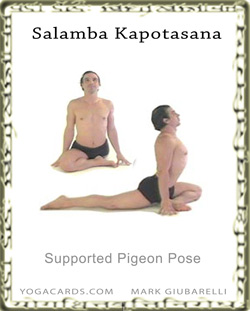
If you just did the Chair Pose Squat Jumps, then your glutes are going to be most appreciate for this stretch. The pigeon pose, or Salamba Kapotasana, is a hip opener that is fantastic in relieving tension in the glutes, IT band, and upper thigh. Do not be intimidated by the picture below!!!  You can ease into the pigeon pose at your rate of flexibility!


hip openers

There are many ways to get into this position, but I will explain the method which I most commonly use.

1-Across the length of a mat, begin in Downward Dog position .
2-Bring the knee of your right leg forward and position your shin as parallel to the edge of the mat as your body allows.
3. With your core as upright as possible and your chest up, begin to lower your core straight down towards the mat. Only go down as far as your body allows. Do NOT force the stretch. It is perfectly alright if you cannot stretch all the way down to the mat!
4. You can use your hands to help keep you upright (as depicted in the picture), or, if your flexibility allows, you can begin to walk your hands out in front of you to get a deeper stretch.
5. Return back to the Downward Dog position in the same manner in which you left it and repeat on the left side.

Namaste.

Exercise of the Day: Dynamic Chair Squats

It's Monday! Time to start your week off right with a great workout for your core and your legs! This is a variation on the Chair Pose from yoga.


To get into position, sit your butt back just like you are about to sit in to a chair. It is very important that it is your butt going backwards; you want to avoid your knees going in front of your toes because this can cause damage to your knees. Try to create as close to a 90 degree angle at your knees as possible, or think about bringing your thighs parallel to the floor. 

Keep your upper body as upright as possible. and raise your arms in front of you, reaching for the ceiling. Lengthen through your spine.

Now that you are in Chair Pose, begin to do squat jumps, maintaining the Chair Pose position as best as possible each time you jump.

To make this a nice mix of plyometric and isometric (working your muscles by holding them still in a flexed position), try this:

Do 12 chair squat jumps and at the end of the 12th jump, hold the chair position for a count of 10. Repeat this for 1 minute. 

You'll feel this exercise in no time!